Download Ebook Information Technology: Inside and Outside By David Cyganski, John A. Orr, Richard F. Vaz
As known, we are the very best publication website that always note numerous points of books from different countries. Certainly, you can discover as well as enjoy browsing the title by search from the nation and various other countries worldwide. It means that you could consider several things while discover the interesting publication to read. Connected to the Information Technology: Inside And Outside By David Cyganski, John A. Orr, Richard F. Vaz that we get rid of now, we are not question anymore. Many individuals have proved it; confirm that this book offers good impacts for you.
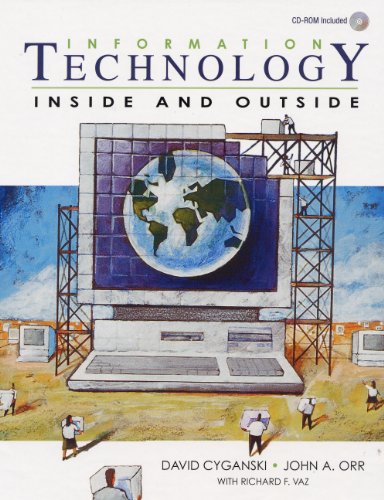
Information Technology: Inside and Outside By David Cyganski, John A. Orr, Richard F. Vaz

Download Ebook Information Technology: Inside and Outside By David Cyganski, John A. Orr, Richard F. Vaz
Challenging the mind to believe much better as well as much faster can be undergone by some methods. Experiencing, hearing the various other experience, adventuring, studying, training, as well as more sensible tasks might help you to boost. However right here, if you do not have sufficient time to obtain the important things directly, you could take an extremely simple method. Reading is the easiest activity that can be done almost everywhere you want.
Checking out is the best point to do to fulfil the time. Yeah, reviewing will always bring goodness. Furthermore, when you can recognize exactly what the book to check out, it's really well prepared. When you can review guide ended up, you could get completed info that the writer utters. In this case, this publication always provides advantages. Information Technology: Inside And Outside By David Cyganski, John A. Orr, Richard F. Vaz naturally will certainly be so crucial to accompany you in your free time. Even it is only couple of pages; you could read it by the times without neglecting just what you have actually checked out.
And why should read this book? Several recognize that in this era, some publications are covered in heavy things to load. A few other will be additionally complemented in language difficulty to comprehend. Information Technology: Inside And Outside By David Cyganski, John A. Orr, Richard F. Vaz is one of the current launched books that has simple idea of assumed with amazing truths and lessons. It will certainly instruct you couple of things easy with very easy language to understand. Also you are from the immigrants, this publication is also simple enough to be translated.
It will assist you to make or become a person much better. Precious times for analysis is gained due to the fact that you don't waste the moment for something problem. When you actually read this book intelligently as well as flawlessly, what you seek fro will certainly be ultimately gotten. To get Information Technology: Inside And Outside By David Cyganski, John A. Orr, Richard F. Vaz in this write-up, you need to get the link. That is the web link of guide to download and install. When the soft file of guide can help you less complicated, why not you make a possibility to get this publication today? Be the first individuals that get this publication here!
- Sales Rank: #844422 in Books
- Published on: 2000-11-05
- Original language: English
- Number of items: 1
- Dimensions: 9.90" h x .90" w x 8.00" l, 1.65 pounds
- Binding: Paperback
- 338 pages
Review
"It's critical for persons in all areas of business to have some familiarity with the rapidly evolving world of communications. This book was the basis for a course at Lucent Technologies focused on introducing financial managers to this area. The material was very successful, got very positive reviews all around, and will continue to be a key part of our education of non-technical managers in important infrastructure markets, technologies, and capabilities."—Donald K. Peterson, Chief Financial Officer, Lucent Technologies
From the Inside Flap
Preface
Information Technology: Inside and Outside has been written as the basis for a one-semester course introducing the engineering behind a modern information infrastructure. This infrastructure is the foundation for the revolution in economic and social systems that we are currently experiencing. The topics covered are suitable for use in a wide range of educational environments, from which educators may select appropriate materials given the preparation of students and the nature of the curricular context. This book may be used to offer courses to students in business, management, law, the arts, the humanities, the social sciences, geography, and other degree programs, but also includes supplementary and deeper treatments that are suitable for students of mathematics, physics, and engineering. We have been careful not to introduce concepts requiring previous exposure to topics unique to preparation in electrical and computer engineering or other technical fields. Audience
The book provides the foundation for a course accessible to students from many Audience different disciplines. Such a course can prepare students to take advantage of new information technologies during the remainder of their education, as well as throughout their careers. The goal of such a course in information engineering is to teach leadership skills rather than just survival skills. Students will be in a position (after further study) to make changes in their particular profession based on the continuing emergence of new information technologies and associated capabilities. Goals
To prepare students from many disciplines to interact with the engineers and service providers of the information infrastructure, we seek in this book to provide knowledge regarding such concepts as the nature of information, bandwidth, types of transmission and storage media, and the fundamental principles governing information technology. We endeavor to give students a systems-level appreciation of information systems, including computer network organization, specification, and economics, so that they will have the context in which to perceive opportunities for these technologies in their professions. Exposure to general networking concepts, in addition to hands-on experience with related hardware and software tools for information capture, conversion, display, and management, will provide students with the knowledge needed to bring the appropriate information-related technologies to bear on their disciplines. Prerequisites
Because of the wide audience that we seek to engage, the exercises in this book likewise address a wide range of backgrounds. This course is intended for first- or second-year students who are not majoring in electrical or computer engineering; thus, the formal prerequisites are intentionally kept to a minimum. Many of the exercises will be within the skill set of first-year students with no special preparation beyond knowledge of college entrance-level algebra. The exercises for these students are aimed in particular at developing skills in key areas.
Communications skills: It is widely recognized that development of written, oral, and visual communications skills is a vital part of education, and that students are frequently deficient in these areas compared to their teachers' expectations. In the context of modern communications media, this course will provide opportunities for students to practice and enhance their abilities in the "old-fashioned" communications principles, including clarity of thought, organization of presentation, and a focus on the goal of the communication. Web skills: Use of the World Wide Web as a tool across the course will ensure that students become familiar with this means for the accessing and archiving of information. Furthermore, an appended HTML version of the book has been included on an enclosed CD in a Web format to enable rapid searches for information and direct linking to virtual laboratory programs that provide every student with a hands-on experience with information technology.
While the formal prerequisites are few, it is very much the intention of this course to build upon students' backgrounds and experience, including precollege experience and preparation. Three broad areas are emphasized for development through the exercises.
Mathematics: Concepts of mathematics will be used to quantify important principles such as information content (of an image, a sound, a document, etc.), and to demonstrate the interrelations among disparate concepts such as auditory and visual acuity, bandwidth, information content, and transmission media limitations. Computer skills: Most students today have some degree of familiarity with computers, but the range of skill levels and understanding varies widely. Some exercises are directed at allowing students with these skills to derive further understanding of information technology by providing a path toward implementation of these technologies with a minimal programming effort. Science skills: By definition, the "physical sciences" deal with the physical world, while the mathematical sciences deal with abstract concepts. In secondary as well as postsecondary education, these branches of science are often kept quite separate. Further, too often students do not achieve an understanding of how their physical world relates to the physical and mathematical sciences. Engineering is the primary discipline that brings these worlds together by the application of science and mathematics to meet human needs. Some exercises in this book bring science to bear on the engineering of systems for humans; this connection can be quite thrilling to novice science majors who may not yet have had the opportunity to experience the power of applying the tools they have been acquiring in a human context.
The version of the book on the CD contains links to a set of Java-based virtual laboratory experiments that are also found on the CD. The integration of Java and Java Script-based applets with the textbook greatly enhances the presentation of the course material by allowing students to experience the underlying components of information technology in action, rather than merely by description. Further, the use of Java provides a great degree of computer system independence for the exercises. Following is a summary of the types of applets that are included:
Applets related to the concepts of digital audio; Applets illustrating the basics of digital imaging; Applets illustrating various approaches to image data compression; Applets illustrating the elements of the computer representation of numbers; Demonstrations of digital data transmission; Demonstrations of error detection and correction coding.
Most of these applets are not simple demonstrations; they enable the student to vary one or more parameters, and observe the results. It is clearly advantageous that students with access to PCs will be able to immediately use these applets as they read the text, rather than having to go to a specific lab where the software must be installed. For details regarding the applets, see the inside front cover.
A review of the list of topics in this book will show many examples of the relationships between the physical and the abstract. These concepts include physical realizations such as images, sounds, and pages of text, related to abstract concepts such as information, bandwidth, and the number systems. Hence, students from all disciplines will have the opportunity to understand the interdependence among many branches of knowledge and, by extension, the value of a broad education in helping people achieve their goals. Acknowledgments
Several persons and organizations deserve thanks for their valuable contributions to this book. The National Science Foundation provided financial support to begin the project, and WPI, particularly president Ed Parrish and provost Jack Camey, have encouraged and supported us. Several groups of Lucent Technologies employees made use of a preprint version of this text, and two groups of WPI students enrolled in experimental offerings of a course based on the initial notes. A large number of students contributed substantially to the creation and refinement of the graphics, software, and content of the book: Joe Alba, Mike Andrews, Deb Fraser, Brian Hazzard, Carleton Jillson, Mike Roberts, Joshua Resnick, Pedro Soria-Rodriguez, and Ryan Tomasetti. The contributions of reviewers Bob Strum, James McClellan, Gordon Couturier, and Jeff Farah are appreciated. Finally, we would like to thank everyone at Prentice-Hall with whom we worked, including David George, Lakshmi Balasubramanian, and our editor, Tom Robbins.
From the Back Cover
This book presents the underlying engineering behind information technology that is transforming our economic and social systems so dramatically. It addresses a need that has arisen from the impact information technology is making on all professions, technical and non-technical. Understanding of information science and engineering, underlying high performance computing and communications is relevant for students from all disciplines today. Covering a broad range of technologies and assuming no formal engineering or computer science background, this book prepares readers to become active practitioners and leaders in the on-going information revolution. Using technology to educate the reader about the technology, the accompanying CD contains links to a set of Java-based virtual laboratory experiments. The integration of Java and Java Script-based applets with the book greatly enhances the presentation of material by allowing the reader to experience the underlying components of information technology in actin, rather than merely in description.
Information Technology: Inside and Outside
By David Cyganski, John A. Orr, Richard F. Vaz PDF
Information Technology: Inside and Outside
By David Cyganski, John A. Orr, Richard F. Vaz EPub
Information Technology: Inside and Outside
By David Cyganski, John A. Orr, Richard F. Vaz Doc
Information Technology: Inside and Outside
By David Cyganski, John A. Orr, Richard F. Vaz iBooks
Information Technology: Inside and Outside
By David Cyganski, John A. Orr, Richard F. Vaz rtf
Information Technology: Inside and Outside
By David Cyganski, John A. Orr, Richard F. Vaz Mobipocket
Information Technology: Inside and Outside
By David Cyganski, John A. Orr, Richard F. Vaz Kindle